How a Fiber Optic Fusion Splicer Works
The Fusion Splicer is one of the most important pieces of equipment for anyone working with optical networks. It allows two fibers to be joined precisely, ensuring extremely low loss and high durability.
Although it may seem complex, the operating logic is simple: align, cleave, approach, and fuse the fiber glass using a controlled electric arc.
Below, you will understand step-by-step how this process works.
1. What is Fiber Optic Fusion Splicing?
Fusion splicing is the process of joining two optical fibers continuously, without connectors.
This is necessary for:
- Network splices (joints)
- Repairing broken cables
- Expanding the optical backbone
- Branching and splice closures
The goal is to create a perfect union, allowing light to pass through the splice with the lowest possible loss.
2. Main Components of the Fusion Splicer
Even though different models exist (core alignment, cladding alignment, ribbon), they all possess:
- Cameras/Microscopes: To view and align the fiber.
- Electrodes: Create the electric arc (voltaic arc) for fusion.
- V-grooves: Channels that hold the fibers in place.
- LCD Screen: Operation interface.
- Automatic Alignment System: Mechanical or image-based.
- Tube Heater: Oven for shrinking the splice sleeve.
- Battery: Or power supply.
3. How the Splicing Process Works (Step-by-Step)
1 – Fiber Preparation
Before splicing, the technician must:
- Slide the splice protection sleeve onto the fiber.
- Strip the protective coating (buffer/cladding) from the fiber optic.
- Clean with lint-free wipes and isopropyl alcohol.
- Perform a perfect cleave using a precision cleaver.
Note: This cleave (cut) must be perfectly flat (perpendicular), as any angle increases loss.
2 – Fiber Alignment in the Machine
The tips of the two fibers are placed into the machine’s V-grooves.
Then:
- Sensors and cameras capture the fiber position.
- Internal software moves motors to center them.
- The machine performs “pre-alignment” and then fine adjustment.
There are two main alignment types:
- ✔ Cladding Alignment: The machine aligns based on the fiber’s outer layer (cladding). It is simpler, cheaper, and common among ISPs.
- ✔ Core Alignment: The machine aligns directly based on the light-carrying core. It has higher precision, ideal for corporate networks and backbones.
3 – Pre-heating and Cleaning Arc
Before fusing, the machine applies a cleaning arc:
- Removes microscopic dust.
- Prevents bubbles in the splice.
- Prepares the glass for fusion.
- This lasts only a few milliseconds.
4 – The Fusion (The Electric Arc)
This is the main part of the process.
The machine:
- Brings the fibers together.
- Discharges an electric arc between the electrodes.
- Temperatures reach over 1500°C (2700°F).
- The glass melts and becomes a single piece.
The control is so precise that the average loss is between 0.01 dB and 0.05 dB.
5 – Splice Reinforcement
After fusion:
- The machine performs an automatic inspection of the splice.
- It displays the estimated loss value.
- It prompts the technician to move the fiber to the heater.
- The splice protection sleeve is heated and seals the splice.
This protects against:
- Bending
- Moisture
- Vibration
- Mechanical tension
4. Types of Fusion Splicers
- Core Alignment: High precision – Professional use (Long-haul/Backbone).
- Cladding Alignment: Cheaper – Common in FTTH/ISPs.
- Ribbon Splicer: Aligns and fuses multiple fibers at once (fiber ribbons).
5. When is Fusion Splicing Necessary?
- Optical cable breaks/cuts.
- Backbone construction (Primary network).
- Interconnecting splice closures.
- FTTH Network expansion.
- Splicing ODFs, NAPs, and Drop cables.
6. Tests After Splicing
After splicing, the technician needs to test:
- Power Meter / Light Source: Measures final loss (attenuation).
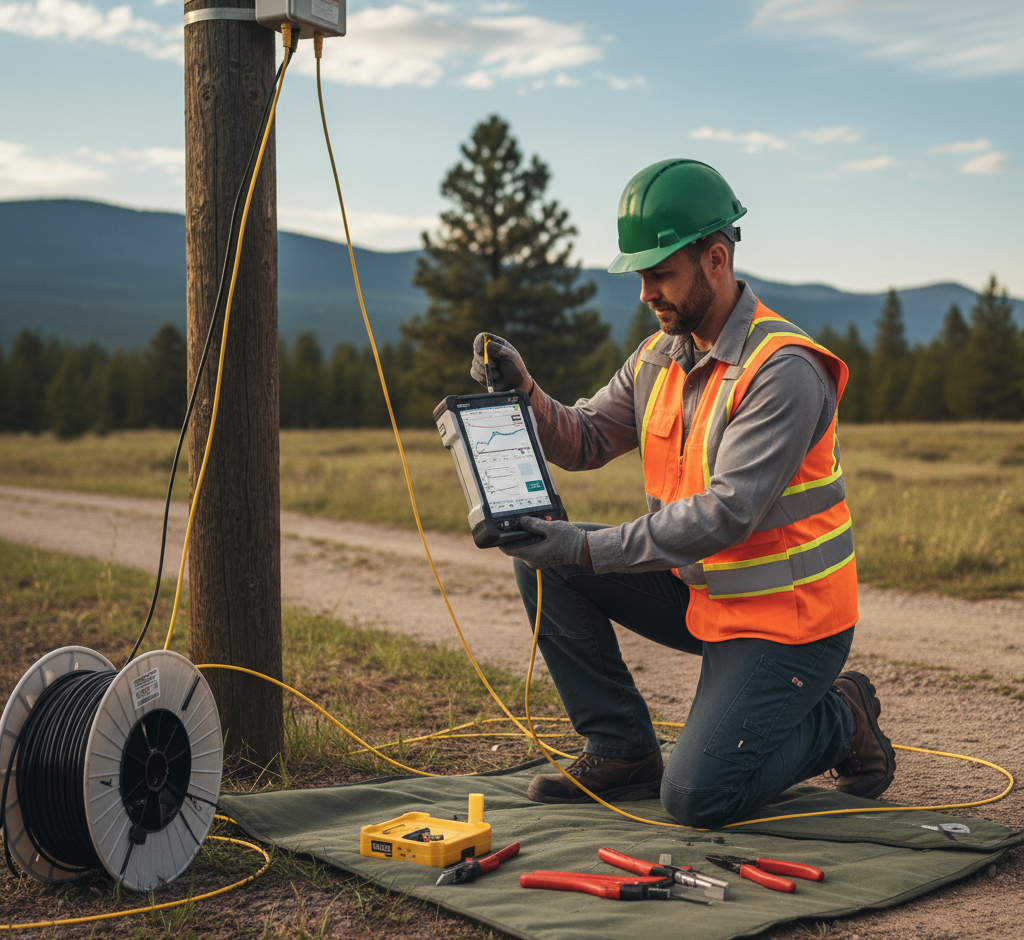
- OTDR: Creates a graph (trace) showing splice quality and location.
These tests are essential in corporate networks and professional ISPs.
7. Final Thoughts
The fusion splicer works by melting and joining two optical fibers with microscopic precision. With automatic alignment, a perfect cleave, and a controlled electric arc, it ensures splices with extremely low loss.
Learning to use one of these machines at the beginning can be challenging, but it is worth it; it is one of the most important tools in networking.