OTDR: How It Works and What It’s Used For
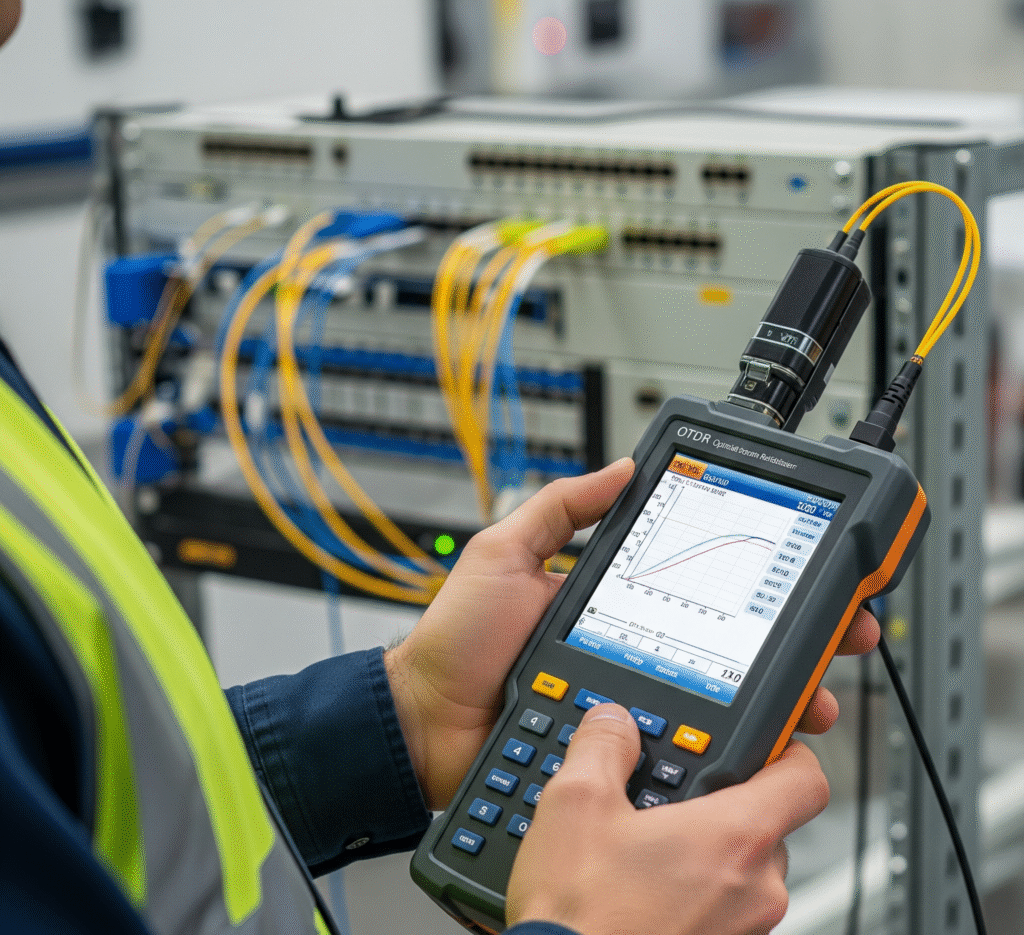
The OTDR (Optical Time-Domain Reflectometer) is one of the most important tools in the work of a fiber technician or network engineer. It is used to test, locate faults, and analyze the quality of fiber optic links, ensuring that all transmission is within standards.
In this article, you will clearly understand what an OTDR is, how it works internally, when to use it, the results it delivers, and why it is indispensable for anyone working with fiber.
What is an OTDR?
OTDR stands for Optical Time-Domain Reflectometer.
It is an instrument that sends pulses of light through the fiber optic cable and measures the return of that light to:
- Identify faults
- Locate loss points
- Measure fiber attenuation
- Detect splices, joints, and connectors
- Map the entire fiber route
- Determine the distance to a break
In other words, the OTDR creates a kind of X-ray of the fiber, showing exactly what is happening along the entire cable.
How the OTDR Works
The operation of the OTDR is based on two fundamental optical phenomena:
1. Rayleigh Backscatter
When a pulse of light travels through the fiber, part of that light scatters back to the source. The OTDR measures this backscattered light to:
- Calculate attenuation along the fiber
- Identify discontinuities
- Measure internal distances
The higher the loss, the lower the level of this return signal.
2. Fresnel Reflection
When light encounters a sudden change in the refractive index, a strong reflection occurs, such as in:
- Connectors
- Poorly made splices
- Breaks
- Broken fiber
- Dirty connectors
- Excessive bends
This reflection appears as a sharp “spike” on the OTDR graph.
The OTDR measures the time it takes for light to return It sends pulses and measures the return time. With this, it calculates:

(Divided by 2 because the light travels there and back).
OTDR: What appears on the graph (Trace)
The result is displayed as a graph called a Trace. It shows:
- Slope: Attenuation (loss) along the fiber.
- High Peaks: Strong reflections (connectors, bad splices, breaks).
- Steps: Fusion splices (non-reflective events).
- Noise at the end: Measurement limit (dynamic range).
- Total fiber distance.
- Events marked automatically by the OTDR.
This is how the fiber technician identifies everything happening in the link.
What is the OTDR used for?
1. Locating fiber breaks
If the fiber is broken at any point, the OTDR shows:
- Where the break is.
- The distance to the point.
- Probable cause (bend, crush, cut).
- Essential for field maintenance.
2. Measuring splice quality The OTDR reveals:
- If the fusion splice was well done.
- If there was excessive loss.
- If there is core misalignment.
- Allows re-splicing if it is outside standards.
3. Identifying dirty or poorly installed connectors
Dirty or poorly polished connectors generate high reflection. The OTDR marks this automatically.
4. Certifying optical links In corporate networks, FTTH, data centers, and backbones, the OTDR is used for:
- Certification.
- Project acceptance.
- Technical documentation of the link.
- One of the main parts for clients to receive warranties from cable manufacturers.
5. Detecting excessive bends (Macro/Microbends) Tight curves cause light to escape the fiber optic core. The OTDR shows points of progressive loss.
6. Mapping the entire fiber route It builds the complete “path”:
- Start
- Splices
- Splice closures
- Splitters
- Connectors
- End spans
- Essential for network maps and troubleshooting.
When does a Fiber Tech use an OTDR?
- After pulling cabling and finishing fiber splicing.
- During maintenance of FTTH and backbone networks.
- Before delivering projects to companies.
- When there is signal loss, power drop, or disconnections.
- During optical network certification.
Types of OTDR
- Multimode OTDR: For MM fibers (850/1300 nm).
- Single-mode OTDR: For SM fibers (1310/1550/1625 nm).
- Handheld OTDR: Lightweight, designed for field use.
- Pen-type / Mini OTDR: Basic functionality.
- Professional OTDR: Modular platforms for both MM and SM.
Important points that many beginners ignore
- Always use a Launch Cord (Launch Cable) in good condition.
- Always protect the equipment ports.
- Always protect the tips of the cords after use.
- Always clean the connectors before and after measurement.
- Correctly configure pulse width and range.
- Avoid testing with active traffic. Warning: only use if the equipment supports Live Fiber Testing.
Final Thoughts
The OTDR is an indispensable tool for any fiber technician working with network installation, maintenance, and certification. It allows you to identify faults, measure splice quality, and ensure the infrastructure is operating within national and international standards.
Mastering this equipment, knowing the ideal configuration, and interpreting events are necessary skills to advance in your career.