Difference Between Single-Mode and Multimode Fiber
Fiber optics is widely used in telecom, data centers, and by Internet Service Providers (ISPs). However, there are two main types: Single-Mode (SM) and Multimode (MM).
The choice between them affects distance, speed, cost, and the type of equipment used.
Below is a detailed explanation of the subject:
1. Single-Mode Fiber (SM)
Principle
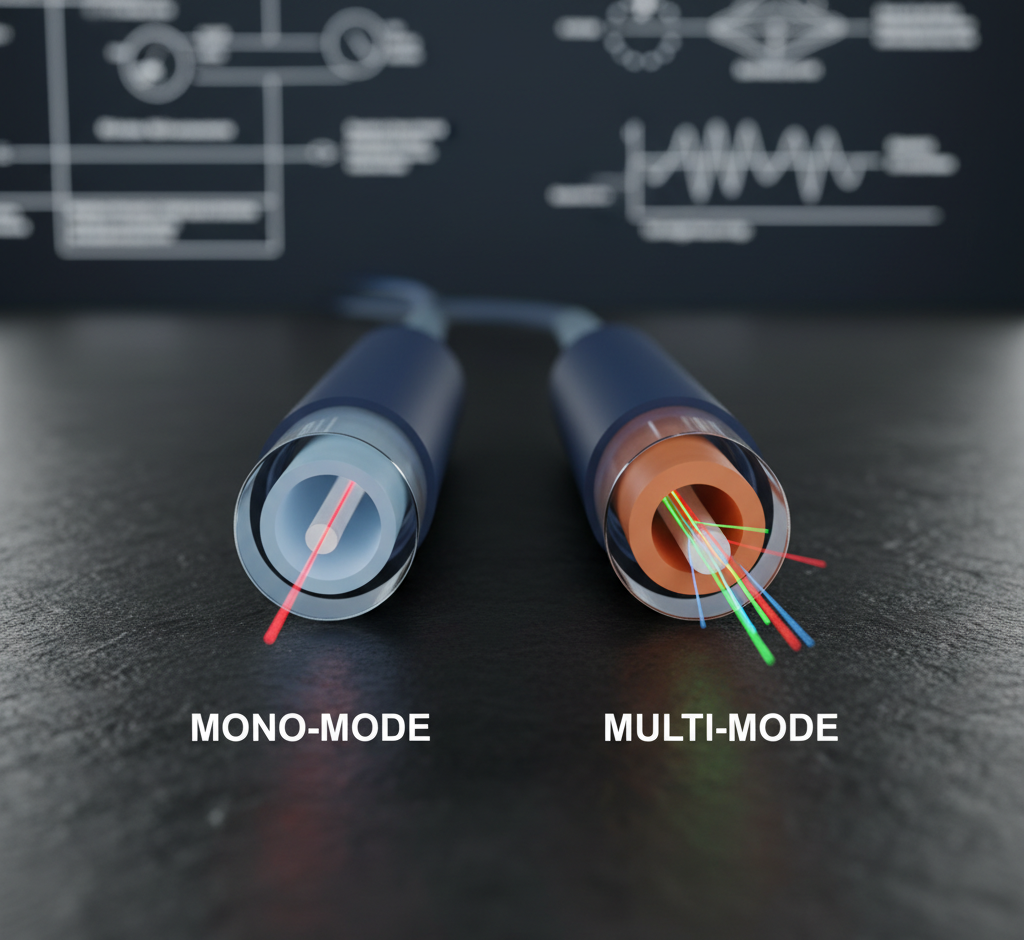
It allows the propagation of only a single mode of light within the core, meaning the light travels in a straight line.
Technical Characteristics
- Core Diameter: ~ 9 µm (microns)
- Wavelengths used: 1310 nm and 1550 nm
- Attenuation: Very low
- Speed: Extremely high (10G, 40G, 100G, and above)
- Distance achieved: Up to tens of kilometers (miles)
Where it is used
- Internet Service Providers (Backbone)
- Long distances between buildings
- Metropolitan Area Networks (MAN)
- Telecommunications
- Long-distance links in shopping malls or campuses
Advantages
- Excellent for long distances
- Greater stability
- Lower signal loss
- Scalable for high speeds
Disadvantages
- Equipment (SFP, optical transceivers) is more expensive
- Installation generally requires greater precision
2. Multimode Fiber (MM)
Principle
It allows multiple beams of light to propagate simultaneously. Since the core is larger than in SM fiber, light can be reflected at various angles.
Technical Characteristics
- Core Diameter: 50 µm or 62.5 µm
- Wavelengths used: 850 nm or 1300 nm
- Distance: Short
- Speed: Good, but limited by modal dispersion
Where it is used
- Small data centers
- Internal corporate networks (LANs)
- Nearby technical rooms
- Short connections between equipment
Advantages
- Great for short distances (up to 550 m / 1800 ft, depending on the category)
- Cheaper optical transceivers
- Simpler installation
Disadvantages
- Higher loss due to dispersion
- Not suitable for long distances
- Lower scalability for very high speeds
3. Typical Distances
| Technology | Multimode | Single-Mode |
| 1 Gbps | Up to 550 m | Up to 10–40 km |
| 10 Gbps | Up to 300 m | Up to 40–80 km |
| 40/100 Gb | Up to 150 m | Up to 80–100+ km |
4. Simple Visual Difference (Patch Cords)
- Single-Mode: Yellow jacket, thin core (9 µm).
- Multimode: Orange or Aqua jacket, thicker core (50/62.5 µm).
Attention: To correctly identify the fiber cable type, you must observe the SM (Single-Mode) or MM (Multi-Mode) markings on the cable jacket.
5. Which one to choose?
Choose Single-Mode if the project requires:
- Distances above 600 meters
- High availability
- Network Backbone
- Medium to large Data Centers
- Outdoor (OSP) installations
Choose Multimode if the project requires:
- Low initial cost
- Short distances
- Connections between nearby equipment
- Simple indoor projects
Key Takeaway
Single-mode fiber is ideal for long distances and extreme speeds; Multimode fiber is better for short distances and lower costs.