Power Meter: How It Works and What It Is Used For
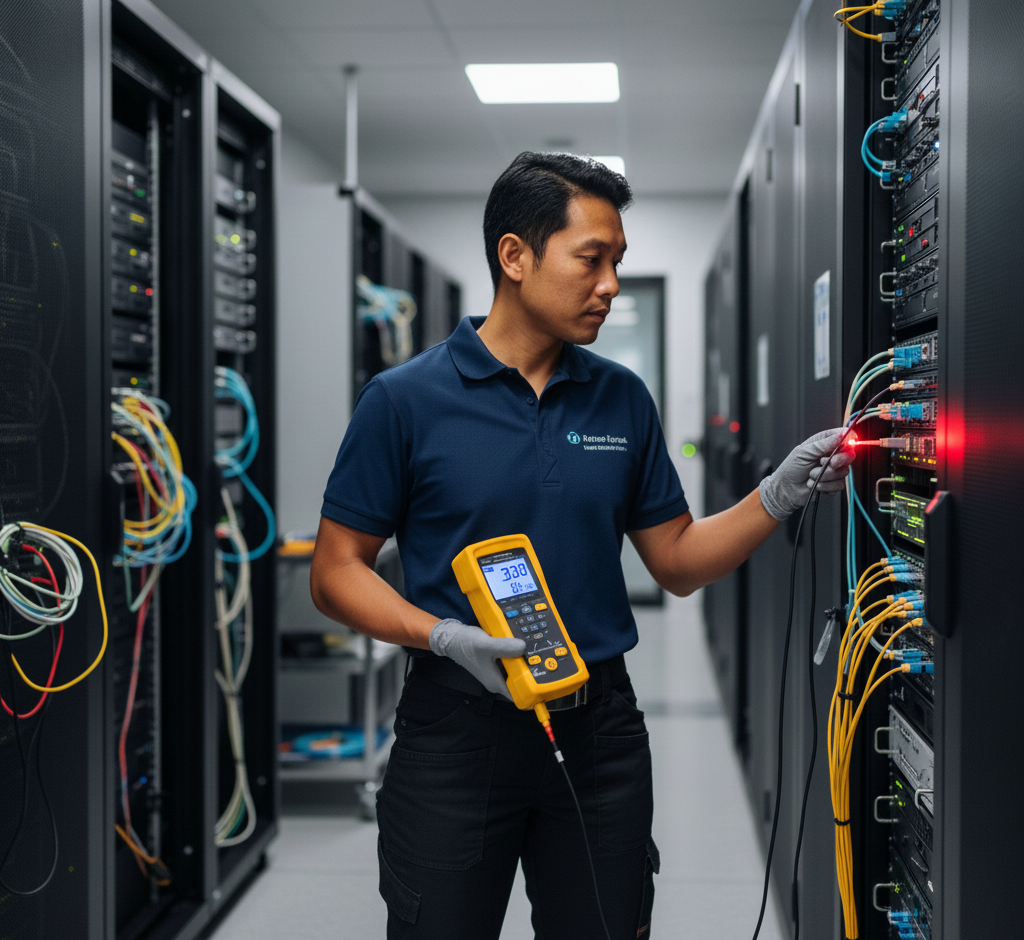
The Power Meter, also known as an Optical Power Meter (OPM), is one of the most important instruments in the daily work of a network cable technician or fiber optic specialist.
It is used to measure the signal power arriving through an optical fiber, allowing for the evaluation of the quality, continuity, and performance of an optical link—whether in FTTH networks, data centers, or corporate infrastructures.
What is a Power Meter?
The Power Meter is a portable and fundamental piece of equipment capable of measuring the power (intensity) of the light reaching the end of a fiber segment.
This light is generally emitted by active network equipment, such as an OLT, ONU, optical switch, or a 1G/10G transceiver. The Power Meter is a critical tool for network link testing, as it is used in conjunction with a Stabilized Light Source (OLS) to measure the total loss (attenuation) of the link.
It displays the received power value in dBm (absolute power) or the loss value in dB (relative power), which are the standard units for measuring optical power.
What is the Power Meter Used For?
The Power Meter is essential for:
1. Verifying if an optical link is operating within ideal levels
Every type of network has a recommended power range. For example, in a GPON FTTH network, the ONU should typically receive a signal between:
- -8 dBm and -27 dBm (values are approximate and vary by manufacturer).
If the signal is too weak (e.g., -28 dBm), the connection may fail or become unstable.
2. Locating excessive losses in the link
If the received power is below expectations, the technician might suspect:
- Dirty connectors
- Poorly made splices
- Fiber breaks (macro-bends or micro-bends)
- Incorrect attenuators
- Distance exceeding supportable limits
- Defective patch cords
The Power Meter does not show exactly where the problem is located, but it confirms that there is loss—helping in the diagnosis before resorting to an OTDR.
3. Testing and certifying fibers after installation
In corporate work or large infrastructures (malls, data centers, airports), every link must be tested and approved. Combined with a light source, the Power Meter allows you to measure:
- Total link attenuation
- Continuity
- Splice quality
- Connectors
- Adherence to the project’s optical budget
4. Measuring different wavelengths
A good Power Meter measures more than one wavelength range, such as:
- 850 nm (Multimode)
- 1310 nm (Singlemode)
- 1550 nm (Singlemode)
This allows for the identification of problems that appear only at specific wavelengths. Note: It is essential to know the type of cable being tested.
How Does the Power Meter Work?
The operation is simple, yet highly technical:
- Light travels through the entire fiber.
- Upon reaching the end, it enters the photodetector sensor of the Power Meter.
- The equipment converts the received light into an electrical value.
- The electrical value is transformed into an optical reading (dBm) displayed on the screen.
- The technician then compares the received value with the optical budget stipulated by the project.
Types of Power Meters
There are three main categories:
- Simple (Read-only): Used for basic tests, common in FTTH networks.
- Power Meter + Light Source (Certification Kit): Used for certification and professional link testing (LSPM – Light Source Power Meter).
- Power Meter integrated into high-level OTDRs: Some OTDRs have a built-in Power Meter for greater practicality.
Which Professionals Use a Power Meter?
- FTTH Cable Technicians
- Specialized Optical Network Installers
- Data Center Technicians
- Corporate Infrastructure Professionals
- Telecom Analysts
- Network Installers
When to Use a Power Meter vs. an OTDR?
| Feature | Power Meter (OPM) | OTDR (Optical Time Domain Reflectometer) |
| Function | Measures real power / total loss | Shows the fiber trace / visualizes the link |
| Diagnosis | Shows if the link is within budget | Identifies where the problem is |
| Usage | Simple and fast | Detailed and complex |
| Best For | Activation and verification | Maintenance, troubleshooting, and deep diagnosis |
| Capability | Detects total attenuation | Detects loss in splices, connectors, and bends |
Ideally, both should be used together.
Final Thoughts
The Power Meter is indispensable for any professional working with fiber optics. It guarantees that the network is operating within the correct levels, helps find loss problems, and is fundamental in link certification.
It is crucial to know which type of equipment will be used; always research thoroughly before selecting your tools.